


UEBERREST | DE 2025 #07
UEBERREST – The Sound of Isolation and Awakening

A Dual Heritage of Silence, Structure, and Emotional Inheritance
There is a certain silence that shapes a person, the kind that comes not from absence but from landscape. For Ueberrest, born Tim Werder, that silence existed in two forms. One belonged to Switzerland, with its deliberate order and structured rhythm of life. The other lived in Sweden, steeped in melancholy, creativity, and a profound musical culture passed down through generations. In the tension between these two worlds, he found his earliest compass as an artist, a place where precision could coexist with emotional depth.
His childhood unfolded in dance studios, surrounded by racks of CDs that held decades of musical history. Swedish emotionality and Swiss discipline intertwined in his environment, allowing him to observe how creativity and structure could act not as opposites but as collaborators. Today, Ueberrest stands at the intersection of these influences, crafting a sound that is both architectural and cinematic, mechanical and deeply human.
That duality remains central to the identity he continues to build. It is the background to The Sound of Isolation and Awakening, a story shaped not by a single breakthrough but by a long, personal evolution. It is the story of a young artist who learned to listen to silence, to find structure in chaos, and to embrace the moments of internal rupture that led him toward a new beginning.
Where Memory Turns Into Instinct
His understanding of heritage is not a fixed memory but an ongoing internal conversation. The contrast between Sweden and Switzerland was never abstract to him. It formed the emotional architecture of his creative mind.
“It is exactly the contrast you mention that plays a huge role in the way I live out my artistic character… Today, creativity and precision go hand in hand for me to create music, not just fantasize about it. It is the mix that makes the magic.”
His earliest connection to sound carries a physicality that remains visible in his music. He still remembers the first sensations: his mother singing as he grew up, the hours spent in the dance studio, absorbing hip-hop, rap, and electronic music. And then, the first instrument that shaped his relationship with emotion and craft.
“My earliest listening memories that I can remember were around the age of five. My mom used to sing for me since I was a baby… My first physical memory is of when I started playing the guitar, which I did for over 8 years. I remember being horrible at reading notes of the songs I had to learn on the guitar. I just memorized what my teacher was playing, and I just repeated it.”
That years-long encounter with the guitar became a foundational discovery: that his musicality came from emotional response, not intellectual analysis. It formed the pillar that still guides him today, the instinct that allows him to let feelings lead structure rather than the other way around.
“Music was never 100 percent logical to me. I always pay attention to what it does to my brain and my body rather than how it is built.”
Before Ueberrest existed, Tim had already begun to feel the friction between expectation and self. Growing up in Switzerland meant growing up inside a cultural system that valued safety and long-term planning. But at twenty-five, something broke open. He could no longer live divided between what was expected of him and what he was becoming.
“Before that, I was growing up among the Swiss culture, which sometimes tends to shape you into having a good education, good job perspective, and doing everything on a safe basis… When I turned 25, I knew that my time had come to start putting this hobby into valuable results.”

Finding Direction Through Rhythm and Rebellion
Techno arrived in his life as something instinctive, a sensation in the body before it became a musical philosophy. It began in a small Swiss village, far from any club culture, where electronic music was not part of the local fabric. What opened the door was curiosity, friendship, and the discovery of a beat that felt unmistakably like home.
“Growing up in a small village in Switzerland, techno was never deeply embedded in our small society. That is why it really helped us to discover house tracks from Swiss artists like Kellerkind… It wasn’t just techno; it was all sorts of electronic music from electro, house, trance, to minimal.”
The scene became real through rebellion. A friend who knew a club bouncer. Nights sneaking into Lucerne venues long before they were of age. Feeling the physical impact of techno for the first time, not just hearing it. This awakening coincided with a new obsession.
“I remember my friend knowing the bouncer at our local club in Lucerne who would let us in even though we weren’t old enough… A school friend introduced me to my first DAW, and I instantly started creating my own music. That was the moment when the grip of inventing my own music held me tight and never let me go.”
The deeper he went, the more techno became not just a genre but a language through which he could structure emotions and create clarity.
“It is hard for me to determine why it became my second nature… Maybe with all the chaos going on in life, electronic music brought some sort of clarity and structure to me.”
His imagination, however, has always transcended genre. Even today, he draws inspiration from hip hop, metal, pop, and classical music, transforming their emotional imprint into his own techno DNA.
“Many ideas come from listening to genres like hip-hop, metal, pop, and even classical music… I try to convert a similar vibe into my own, but in techno.”
And then came the moment that changed his life, the moment that turned the idea of Ueberrest into something irreversible.
“At one point, I was just so unhappy with who I was becoming as Tim that I stopped caring about how it’s done… Then came the day when I saw that Max Kobosil downloaded one of my tracks. That was the ultimate turning point in my life.”
He went to see Kobosil perform in Switzerland, unsure if anything would happen. But then he heard it: his track, played in front of a crowd that moved to his rhythm.
“I will never forget the moment I heard him play my track and saw all the people dance to it. That was my ultimate point of no return.”

Stepping Into Purpose
By 2025, he made the decision that separates dreamers from artists. He quit his job and entered the unknown with no safety net, guided not by certainty but by necessity.
“Eventually, my decision to quit my job came from my ‘all or nothing’ thinking… At the end of the day, the regret of not taking risks always outweighs the regret of taking them.”
The leap did not change his sound so much as sharpen his freedom. Music had always been his refuge. Now it had become his full-time reality, offering both pressure and liberation.
“Music has always been a safe space for me, no matter what was going on in my life.”
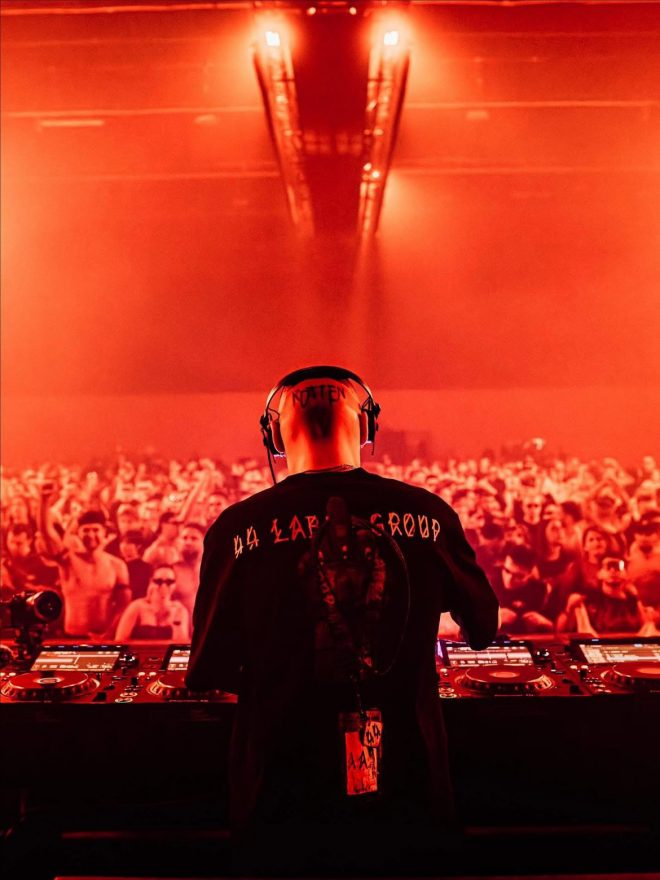
Joining 44 Label Group gave him a home where his identity could evolve without compromise. The emotional impact of that support came full circle during his first gig, a pivotal moment in which he played an entire set of his own productions.
“On my first gig, everything I was taught was confirmed by the reaction of the crowd. I played an entire set with my own productions, and people loved it.”
As an artist, his sound balances intensity with vulnerability. That balance comes from a process rooted in sensation rather than logic. And often, that process starts with melody.
“Sometimes I just spend hours playing melodies without even thinking about whether they could fit in any tracks of mine.”
It is this unpredictable unfolding that guides him toward tracks that feel true, tracks that carry his spirit rather than a predetermined formula.
“Most important is that my spirit is captured inside the track. How I get there is secondary for me.”

A Future Built on Connection
Looking forward, he does not measure success in stages or scale but in impact. What matters most is the way his music touches people, the way it creates a sense of belonging or escape, the way it moves them toward something lighter.
“Every message I get from people telling me that my music is impacting their life in something positive is one more reason not ever to stop.”
His purpose is not rooted in ambition but in alignment, in the deep feeling that he is where he is meant to be. This path is not a destination but a continuous unfolding of identity, collaboration, and emotional expression.
“As long as a sense of belonging to something or escaping from something can be submitted through my music, I know that I am positively impacting people… I am definitely far from done.”
And that is the essence of Ueberrest’s awakening. His music carries the imprint of two cultures, a childhood of emotional memory, and a journey defined by both rebellion and precision. What he offers the global electronic landscape is not just sound, but connection. Not just intensity, but resonance. Not just evolution, but conviction.
My Thoughts
What stays with me after going through this interview is the clarity of who Ueberrest actually is beneath the artist profile. Not the rising name on a label, not the producer with growing momentum, but the person who had to dismantle a version of himself to become someone he could actually live with.
The throughline in all his answers is not ambition or confidence. It is honesty. Honesty about how he learns, how he feels, what shaped him, what frustrated him, what pushed him, and what saved him. His story is not a straight line, and it shouldn’t be. It is the result of living between cultural expectations and emotional instincts, between stability and unrest, between who he was raised to be and who he needed to become.
What I see most clearly is that his evolution did not come from rebellion for its own sake. It came from recognizing that he could no longer ignore the parts of himself that were being muted. He did not chase music because it was glamorous. He moved toward it because everything else made him feel disconnected from himself.
The Kobosil moment wasn’t magic. It was confirmation. Proof that the world could finally reflect back to him what he always felt internally but never saw mirrored externally. That moment didn’t create his purpose; it validated it. It gave him permission to step fully into something that had been quietly building for years.
And beyond the music, what defines him is his relationship with feeling. He creates from instinct, from mood, from inner shifts that he doesn’t try to control. He trusts unpredictability. He listens to himself even when the logic isn’t apparent. That is not disorganization; that is self-awareness functioning at a deeper level.
What I take away from all of this is that Ueberrest is not constructing a persona. He is letting himself exist more fully. His decisions make sense when you understand the psychology behind them. The label gives him belonging. Quitting his job gave him freedom. Producing gives him clarity. Melody gives him direct access to himself. The connection with listeners gives him a reason to keep growing.
If I had to define the essence of who he is after reading this entire interview, I would say this:
He is someone who chose alignment over expectation. Someone who learned to trust feeling over fear. Someone who builds from inside rather than outside. Someone who sees music not as a career but as a place where he recognizes himself without compromise.
And because he chose that path, everything that follows now is not noise. It is truth.
