


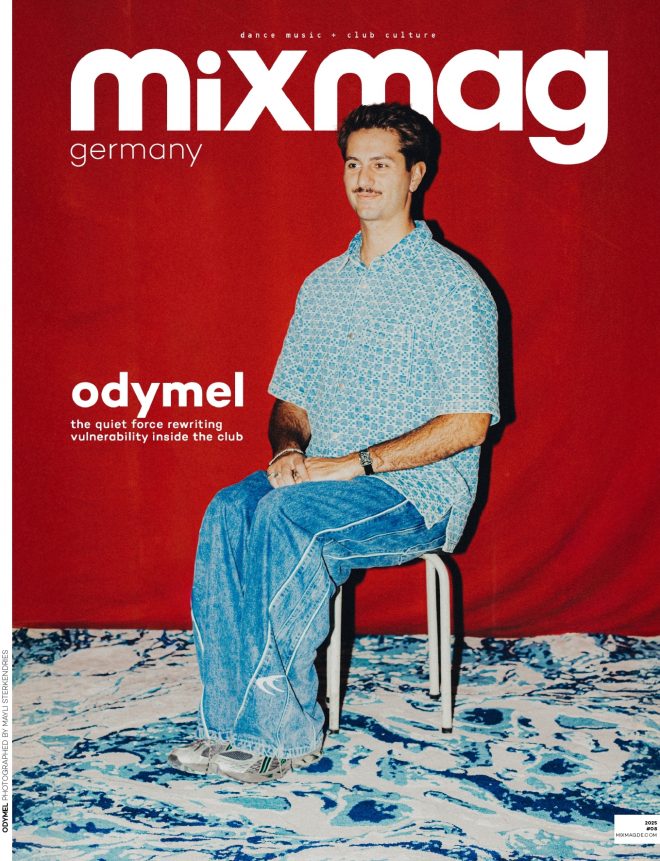
ODYMEL | DE 2025 #08
The Quiet Force Rewriting Vulnerability Inside the Club
BRUSSELS, INFINITY, AND THE FIRST SPARK
Brussels has a way of revealing itself slowly. It doesn’t impose rhythm on you the way Berlin does, nor does it seduce you with the architectural drama of Paris. Instead, it hums softly in the corners of its narrow streets, in the muted glow of its late-night cafés, in the way the city seems to inhale before the night begins. It is a city that invites introspection even as it nurtures intensity. A city that never entirely abandons its melancholic undercurrent, even when its clubs reach peak euphoria.
For Odymel, this paradox is not just environmental. It formed the bedrock of his musical identity. Brussels shaped him quietly but profoundly, giving him a sense of emotional dimension that few cities offer so naturally. There is no singular sound in Brussels; instead, there is a spectrum of feelings. Dance music here breathes differently. It moves with patience. It builds with intention. It holds both brightness and shadow at once, allowing its artists to develop an instinct for complexity while keeping their emotional center intact.
Before he ever stepped foot inside a rave, those sensibilities were already growing inside him. Not because he understood them, but because he felt them. Before adolescence, before adulthood, before any sense of artistic identity, he was already tuned to a frequency that would define his future work.
His story begins long before sold-out nights and festival stages. He returns instead to a childhood bedroom, the hum of a computer fan, the glow of a screen, the first time he opened Logic. He was twelve. Young enough to feel limitless. Young enough to remain untouched by rules. Young enough that every sound felt miraculous.
“I remember how every single thing felt new: a song, a plugin, a genre I’d never heard before, even a feature on Logic I didn’t understand yet. Each discovery felt like a door opening into a world that felt bigger than anything I knew. I had ideas every minute. It felt like there was no limit to what music could be.”

In that moment, electronic music was not a culture, a career, or a community. It was a playground. An infinite one. A place where the laws of the world didn’t apply. He remembers the sensation clearly: the feeling that each day could expand into new directions, that creativity could stretch beyond the boundaries of what he had heard before, that his imagination could build universes no one else could see yet.
That sense of boundlessness is the root of Endless Recess. Not nostalgia itself, but the emotional condition that nostalgia points toward. The memory of freedom before awareness. Joy before time surfaced. Curiosity before the world asked for results.
He returns to that memory often, not because he misses childhood, but because he tries to recreate its emotional conditions inside his process. And buried deep inside those early years is a sensation he never quite forgot: the sense that joy, no matter how intense, always carried an expiration date.
“Every time I was having fun, at some point I’d suddenly feel time catching me. Like if joy had an expiration date. That’s why the idea of a moment that doesn’t collapse on itself became so important.”
Endless Recess is built around that idea: the attempt to create an experience that resists the intrusion of time. A moment that stretches, softens, and expands. A moment that refuses to close just because the world expects it to.
But emotional philosophy alone doesn’t make an album. What makes Endless Recess coherent is the visual world behind it. For some producers, sound comes first. For others, technique. For Odymel, it has always been a mental image that guides him: a dancefloor he has carried with him since childhood.
“I always see a dancefloor. I’ve seen it since I was twelve. It changes with time and age, but the spirit stays the same: a dark room, a good sound system, people smiling from start to finish, strangers becoming friends. People are losing track of time together.”
This mental dancefloor is not tied to any real club. It is not Fuse, not C12, not some Berlin basement or Ibiza warehouse. It is a composite of every emotional experience the rave can hold: a place where people become softer with themselves, where strangers dissolve into collective joy, where music invites vulnerability instead of demanding performance.
In this imagined room, no one is posing. No one is performing identity. The dancers look at each other with curiosity, not evaluation. They feel more than they think. They surrender instead of strategizing. This emotional world serves as the compass for the album. It is why his tracks take their time, why melodies bloom slowly, why drops aren’t built with violence but with emotional coherence. Why the album feels like a night lived from the inside out.
Brussels sharpened this intuition long before he recognized it. The city’s clubs, even at their most intense, carry a certain warmth. A certain sincerity. A specific unspoken agreement that the rave is not just a place to escape, but a place to exist more fully. This feeling quietly shaped him, giving him a sensibility that would naturally evolve into the emotional maturity of Endless Recess.
But emotional foundations are not enough to fully shape an artist. Odymel’s identity is built on a dual sensitivity: the wide-eyed curiosity of the child who discovered Logic and the introspective awareness of the adult who understands that time eventually touches everything. His music exists in the space between those forces, always trying to outrun time while acknowledging it at the exact moment.
That tension is what gives Endless Recess its emotional weight.
And it’s what makes Odymel a singular voice in today’s landscape.

THE SOUND OF A NIGHT THAT REFUSES TO END
Before Endless Recess ever became a title, before it became a body of work, it existed as a feeling, a feeling shaped by moments that don’t follow the line between day and night. Moments where time folds in on itself and the hours melt, repeat, almost like the pulse of a living organism. For Odymel, these were the nights that mattered, the nights that lingered long after the music stopped, the nights that reorganized something inside him. It was these nights, not theory, not strategy, that became the blueprint for the album.
He often describes the project not as a story, but as a lived sequence. A sequence that refuses structure in the traditional sense and instead follows the emotional arcs that define unforgettable nights out: excitement, release, introspection, laughter, stillness, connection, disorientation, expansion. In his mind, it always began with people he cared about, people whose presence made the ordinary dissolve.
“I didn’t build the tracklist like a story. I built it in a night. Highs, lows, raw moments, laughter, silence. The order follows the rhythm of that imaginary moment.”
This decision is part of what gives Endless Recess its depth. The album never tries to force emotional progression. It moves the way the night moves: breathing, stretching, collapsing, rebuilding. Some tracks radiate warmth instantly, as if greeting you at the doorway of the night. Others arrive slowly, like those quiet moments when you step outside the club for a breath and realize you’re thinking about things you didn’t expect to confront. And then, right when you’re least prepared, the music lifts you again, pulls you back toward the center, reconnects you to the collective heartbeat.
That heartbeat is a melody. For Odymel, melody is not just a component of production; it is the core of emotional transmission. And nothing reveals this more clearly than his instinctive bond with the harmonic minor scale, a nuance that shapes the soul of Endless Recess.
“It’s just one note that changes between natural minor and harmonic minor, but that note changes everything. It adds depth, drama, and a kind of emotional tension I can’t resist. Gucci wouldn’t hit the same without that specific note.”
He talks about this note as if it carries weight, and in his music, it does. The raised seventh of the harmonic minor becomes a subtle emotional hinge: part longing, part flare, part unresolved question. It’s what lets the music shift from euphoric to reflective without breaking tension. It’s what makes the melodies feel strangely familiar yet quietly dramatic. It’s what gives the album the duality, defining his artistic character.
But the album is not defined only by technical choices. Emotional instincts define it; instincts shaped in large part by the early 2000s French electro era that first captivated him as a kid. The era that made imperfection feel human, that made drama feel honest, that valued authenticity over technical precision. It was a period when producers cared more about how the music hit the heart than how it sat on a spectrum analyzer.
“What I love about French electro back then is that it wasn’t trying to be perfect. It wasn’t trying to fit anything. It just wanted to make you feel something. That era was innocent, and creativity was insane.”
That innocence stayed with him. He absorbed it not as a style, but as a philosophy: the belief that music should move you before it impresses you, that sound design should breathe rather than show off, that imperfection can carry meaning. This philosophy is part of what makes Endless Recess feel so emotionally direct. It doesn’t hide behind technical polish. It doesn’t pretend to be larger than life. It moves with sincerity, confidence, and vulnerability.
This sincerity extends into his collaborations. He works only with people he genuinely connects with on a human level, not out of selectiveness or ego, but because emotional safety unlocks creative truth. It’s an approach that has profoundly shaped the album, primarily through the contributions of Boy and Girl, Durdenhauer, HARD CANDY, and Fenrick.
“These collaborators are people I appreciate on a human level. I need that. When I’m comfortable, new ideas open up. Each collaboration unlocked something different in me.”
What these collaborators unlocked was not variation, but dimension. They allowed the album to stretch outward without losing its center. To become playful without losing sincerity. To become expansive without losing intimacy. Their presence brought new angles to Odymel’s emotional universe, revealing parts of him that only emerge in conversation, musically and personally.
This openness is what eventually pushed him into the most vulnerable moment of his career so far: exposing his own voice. J’aimerais is not just a track on the album. It is a threshold, a moment where he allowed himself to be seen without filters.
“I never liked my voice. I was scared of it. It took a year and a half to finish that track because I needed to accept myself in it. But even if it’s not perfect, I learned to love its imperfections. They feel human.”
There is a particular tenderness in the way he describes this process. The hesitation. The self-doubt. The slow journey toward acceptance. What emerges is not an attempt to prove vocal ability, but an effort to reveal something personal. Something that would have remained hidden had he stayed behind the safety of his production.
This vulnerability is the quiet center of Endless Recess. It broadens the emotional spectrum of the record. It expands the possibilities of what dance music can express. It lets fragility coexist with rhythm, and introspection coexist with euphoria. It allows the album to feel human, in the deepest sense.
But vulnerability does not exist only in the studio. It follows him into the world, especially as his audience grows. And in 2024, it grew quickly. Very quickly. Faster than he anticipated. Shows that once felt distant suddenly became reality. Moments that once felt unreachable became part of his calendar.
Yet none of these moments resonated quite like the night he sold out Ancienne Belgique, a venue that carries emotional weight for anyone from Brussels.
“It’s been surreal. Those moments helped me believe in my music, because I doubt it a lot. And AB… AB is a dream. It feels like the first time I can express my music 100 percent.”
This night didn’t just boost his confidence. It recalibrated something inside him. It made the invisible visible: the connection between his internal and external worlds. The truth was that people weren’t just dancing to his music; they were feeling it. They were finding themselves inside it.
Tomorrowland amplified visibility.
Ancienne Belgique amplified meaning.
And somewhere in that combination, something shifted.
Not in his ego, but in his understanding of what comes next.
Because if Endless Recess represents a suspended moment, the world around him is moving again. And he is moving with it, toward a future that he knows will demand even more openness, more honesty, more emotional clarity.
The question is not whether he’s ready.
It’s what version of himself he will bring forward.
